
"Patria es humanidad"
Reflections on a solidarity brigade to a Cuba under siege.
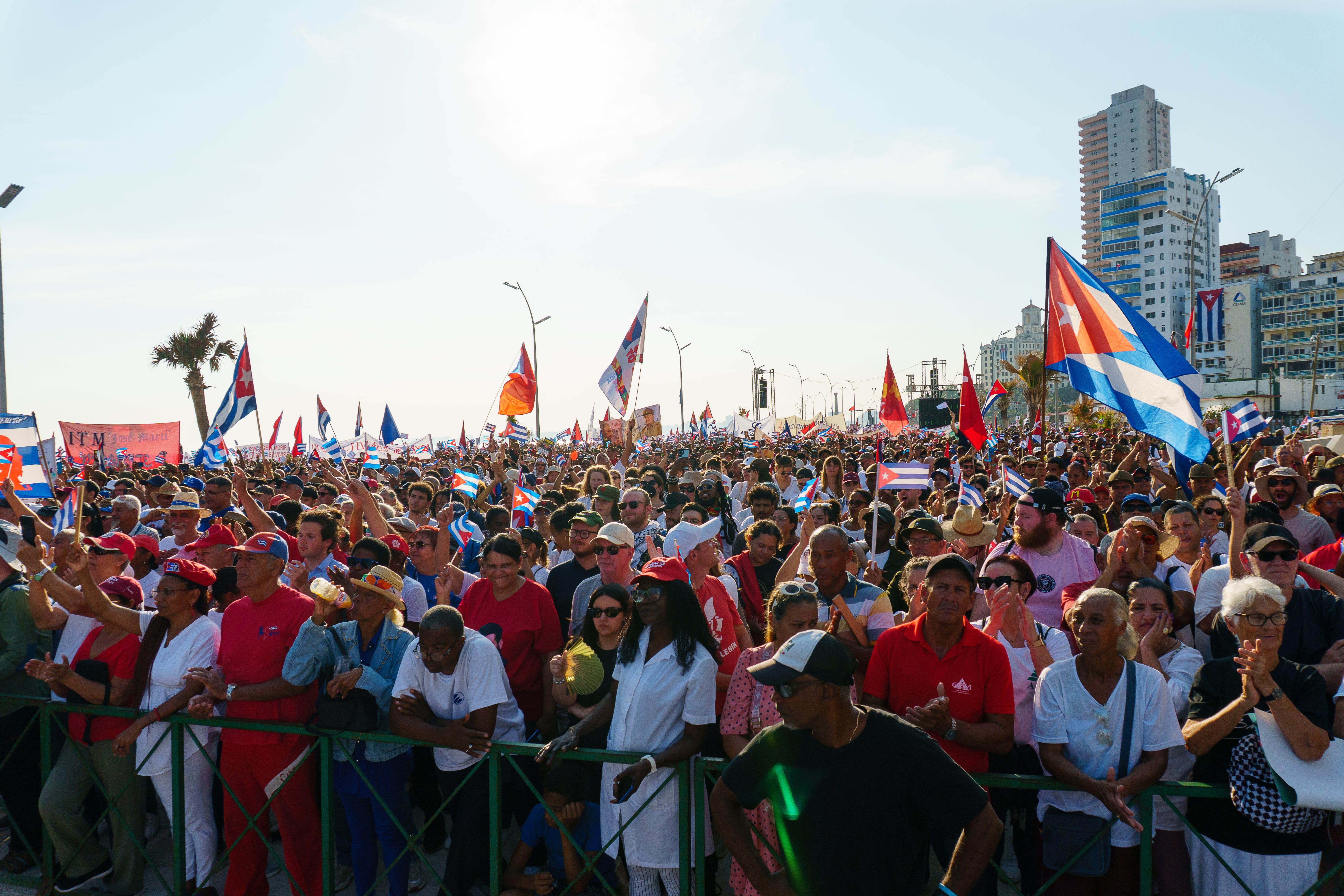
Hours before dawn on the morning on May 1st,1 I found myself in La Plaza de la Revolución, surrounded by revolutionary iconography and towered over by a monument to the Cuban national hero José Martí. We’d just spent an hour watching wave after wave of Cubans come marching into the square cheering, waving flags, and playing music and had joined the crowd in the center of the square waiting for the May Day march to begin. Cuban flags flapped across the air above the crowd, rivaled in number only by the Palestinian flags.
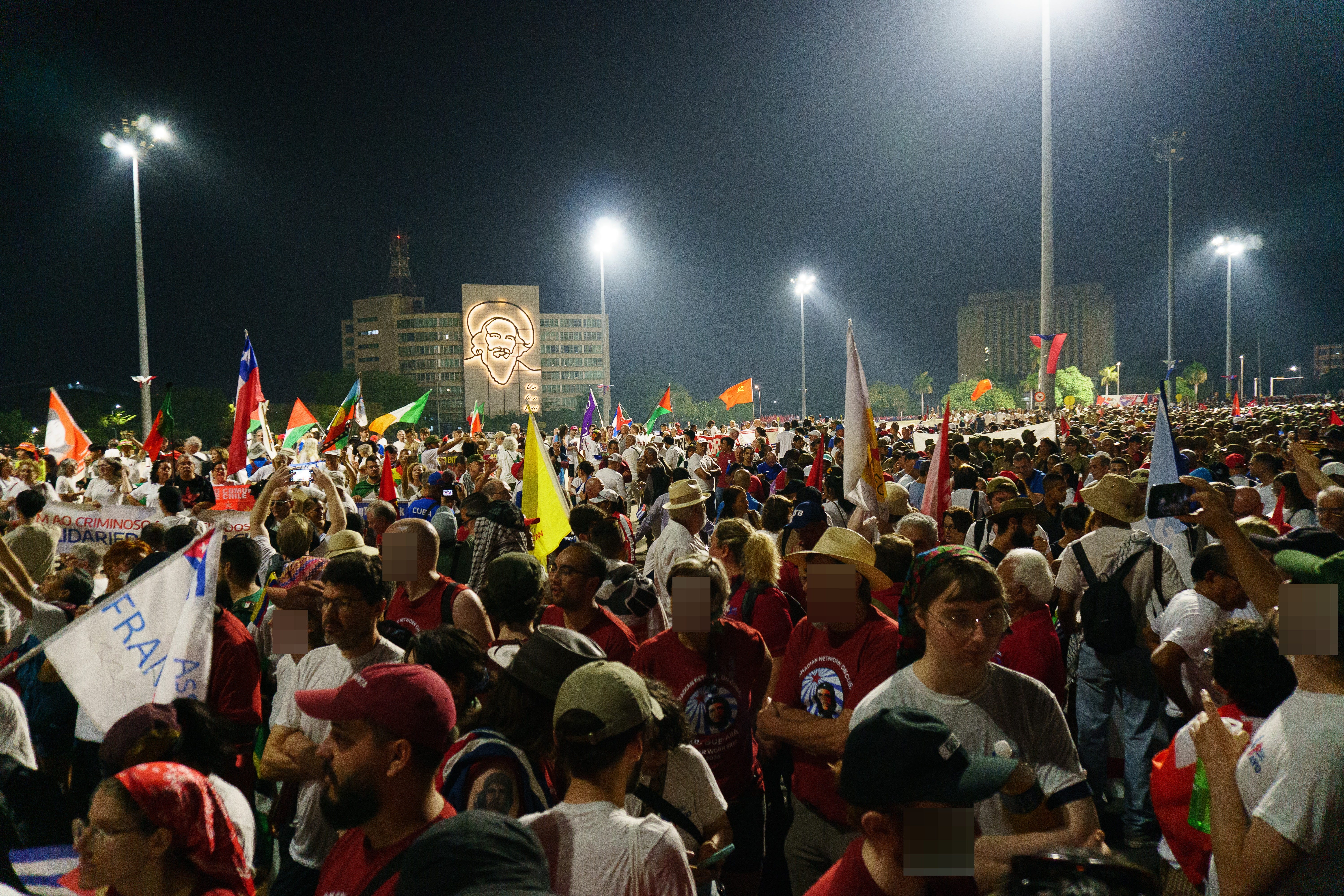
We marched from Revolution Square to Havana’s waterfront, reaching the ocean just as the sun began to rise on the horizon. Tens of thousands gathered at the Tribuna Antiimperialista, spilling far into the streets in every direction—an incredible “fuck you” to the US Embassy (and CIA station) that stood imperiously a few hundred meters away.
I traveled to Cuba as part of the Canadian Network on Cuba’s 32nd annual Che Guevara Volunteer Work Brigade. I’ve mentioned Cuba in my writing and teaching before—it’s hard to write about imperialism without doing so—but I had never been actively involved in Cuba solidarity work. I didn’t know what to expect from the trip, but I chose to go because of the Trump administration’s radical escalation of economic warfare and threats of actual, kinetic warfare over the last few months, both of which are continuing to escalate as I write this. It felt important to be there physically, putting my own body on the line as my country of origin’s warmonger in chief threatened to bomb a peaceful people to oblivion.
There is obviously a lot that can be said about Cuba, but I want to focus on two things: what stood out from our visit there about how Cuba, the Cuban people, and the Cuban revolution are managing the short- and long-term impacts of the blockade, and some reflections about ideological and strategic lessons Cuba holds for activism in the global north.
A brief history of Cuba
Before the revolution
Like most of Latin America, Cuba was first colonized by the Spanish, who may well have been the most brutal of all colonizers (though the competition was stiff). The Spanish massacred the Indigenous peoples of the Caribbean and launched a high-velocity form of the slave trade to supply the labor needed for their plantation economies. For most of the period of Spanish colonialism (though to be clear this was not unique to the Spanish), they found it more profitable to work slaves to death in a matter of weeks or months and replace them with freshly kidnapped Africans than to allow slaves to reproduce.
Their masters...burned them alive, roasted them on slow fires, filled them with gunpowder and blew them up with a match; buried them up to the neck and smeared their heads with sugar that the flies might devour them; fastened them near to nests of ants or wasps; made them eat their excrement, drink their urine, and lick the saliva of other slaves (James, C.L.R., 1989, p. 12)
An excerpt from C.L.R. James’s description of early plantation practices in neighboring Haiti in Black Jacobins.
At the end of the 19th century, the US defeated the Spanish in what is generally called the Spanish-American War. It is often taught as though it was a war of liberation that drove European colonialism out of the region, but multiple territories “liberated” by the US during that war remain under its colonial control today. Others, like Cuba and the Philippines, have been struggling to shed the yoke of US domination ever since.
Cubans had waged multiple wars of their own against the Spanish in bids for independence, including a brutal war beginning in 1895 that played a key role in the initiation of the Spanish-American War. After “liberating” Cuba from the Spanish, the Americans proceeded to occupy the island for four years, withdrawing only after the Cubans established a constitution that enshrined the right of the US government to intervene in Cuban affairs whenever it felt like it. The US military occupied the country for three additional years beginning in 1906—naturally, of course, to ensure “free and fair elections,” as the US always does (in reality, to protect the assets of US capitalists).
The Government of Cuba consents that the United States may exercise the right to intervene for the preservation of Cuban independence
An excerpt from Article III of the 1903 Cuban-American Treaty of Relations, which ironically seeks to protect Cuban independence by establishing Cuban subjugation.
Until 1952, the country was governed as a republic operating within the US political umbrella with various ups and downs, an active labor movement, and so on. In 1952, with direct US backing, a man named Fulgencio Batista, formerly an elected president of the country, suspended the constitution and imposed a dictatorship characterized by repression, polarized wealth accumulation, and close alliances with the US government, US capital, and US-based organized crime, all of which had strong footholds in the country. Look up “Meyer Lansky” for more on the latter.
This is the context of the Cuban revolution, which began in spirit in 1953, when Fidel and Raúl Castro led a failed attack on Batista’s Moncada Barracks. The revolution began in earnest in 1956 when the Castro brothers, accompanied by a group of guerillas who had been training in Mexico, landed back in Cuba to fight for the island’s independence from Batista and US domination. The story is one of larger-than-life, almost unbelievable (but well-documented) heroism, and I encourage you to read about it elsewhere. I’ll just say here, to whet your appetite, that Fidel and his group were ambushed upon landing. Just 12 of them escaped into the Sierra Maestra mountains, shoeless, weaponless, and largely in a state of despair. Fidel turned to his comrades, smiled, and (reportedly) said, “Now, yes, we have won the war!”
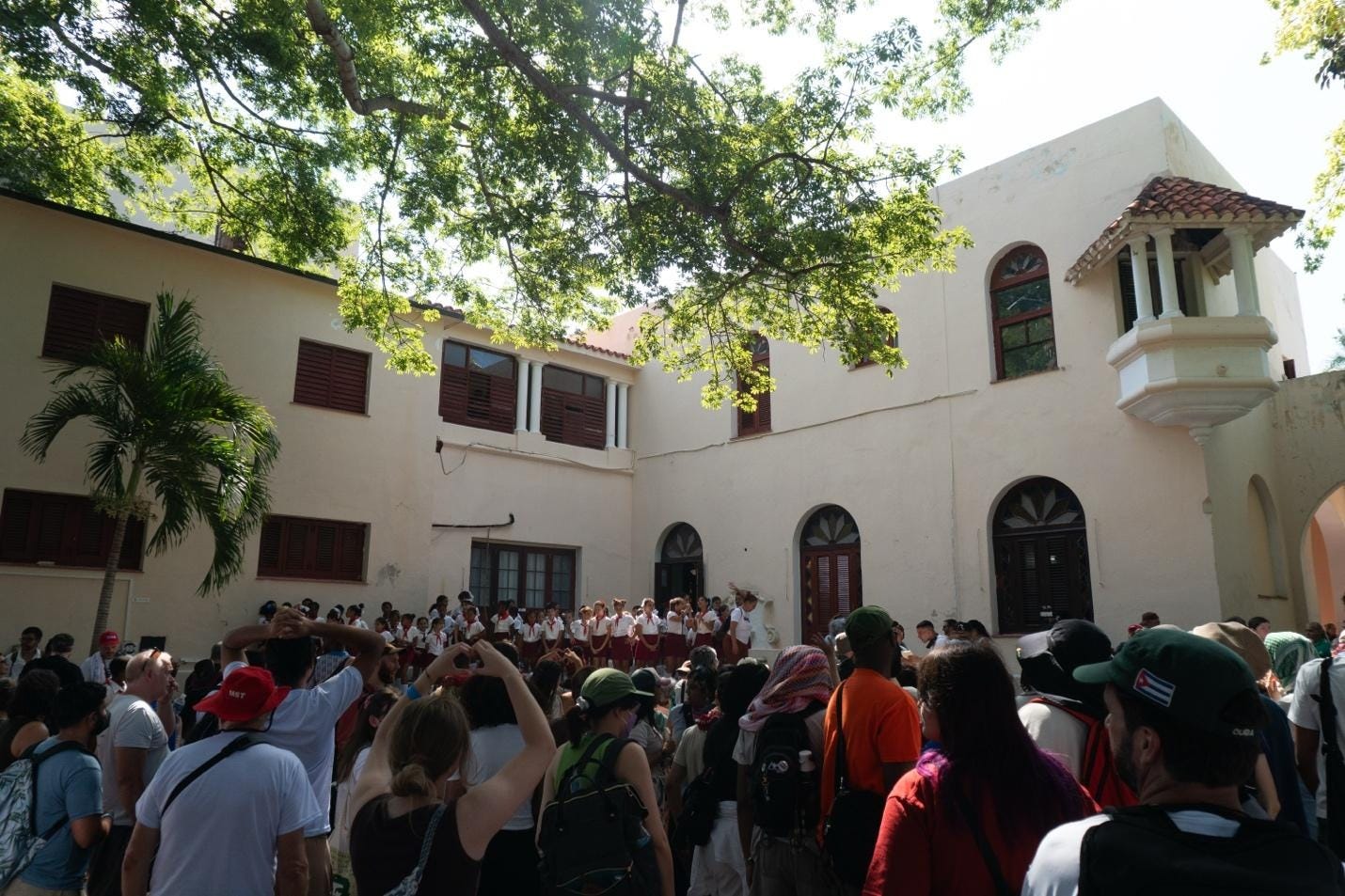
Sure enough, Fidel was right, and on January 8th, 1959, the revolutionary leaders rode into Havana. Batista had fled the country—with vast amounts of wealth, including, according to some, the gold in the national bank’s vault—just days earlier.
After the revolution
In just its first few months, the new revolutionary government nationalized major industries and instituted agrarian reforms that broke up the large landholdings that had been entrenched since the colonial era. Over the course of those same months, the US went from recognizing the new Cuban government to actively fomenting its demise, launching the CIA’s strategy of arming Cuban counterrevolutionaries to try to overthrow the government, something that continues to this day. As the US government oriented itself toward regime change, it pushed Cuba toward closer relations with the Soviet Union and more hostile relationships with US companies that had operated in the country.
In 1960, US-owned oil companies refused to refine oil that Cuba imported from the Soviet Union. Cuba responded by nationalizing the refineries and operating them through the state. This is the basis for ExxonMobil’s present-day claim that Cuba owes them $1 billion—one of Trump’s less subtle justifications for his war on the country.
By the end of 1960, Eisenhower had imposed a trade embargo blocking US exports to Cuba, the beginnings of what we know today as the blockade. The war on Cuba continued to escalate after John F. Kennedy took power despite the new president’s anti-colonial rhetoric. In 1961, a Cuban-American militia organized, funded, and armed by the CIA invaded Cuba—the Bay of Pigs Invasion. Much to the CIA’s chagrin, Kennedy, furious that he had been convinced to go along with this plot that predated his administration, refused to deploy the US military to back the insurgency and the Cubans repelled the invasion. Despite his break from the CIA on the Bay of Pigs, though, Kennedy continued to escalate the US government’s economic war on Cuba, instituting the blockade that persists to this day in 1962.
The blockade is often called an “embargo” in US government communications and US media. Eisenhower’s initial export ban could plausibly have been called an embargo, but the array of policies (over 200) that has accumulated since then goes far beyond an embargo, and the deliberate use of that term by US government entities is designed to downplay the illegality and the unilateral nature of the blockade.
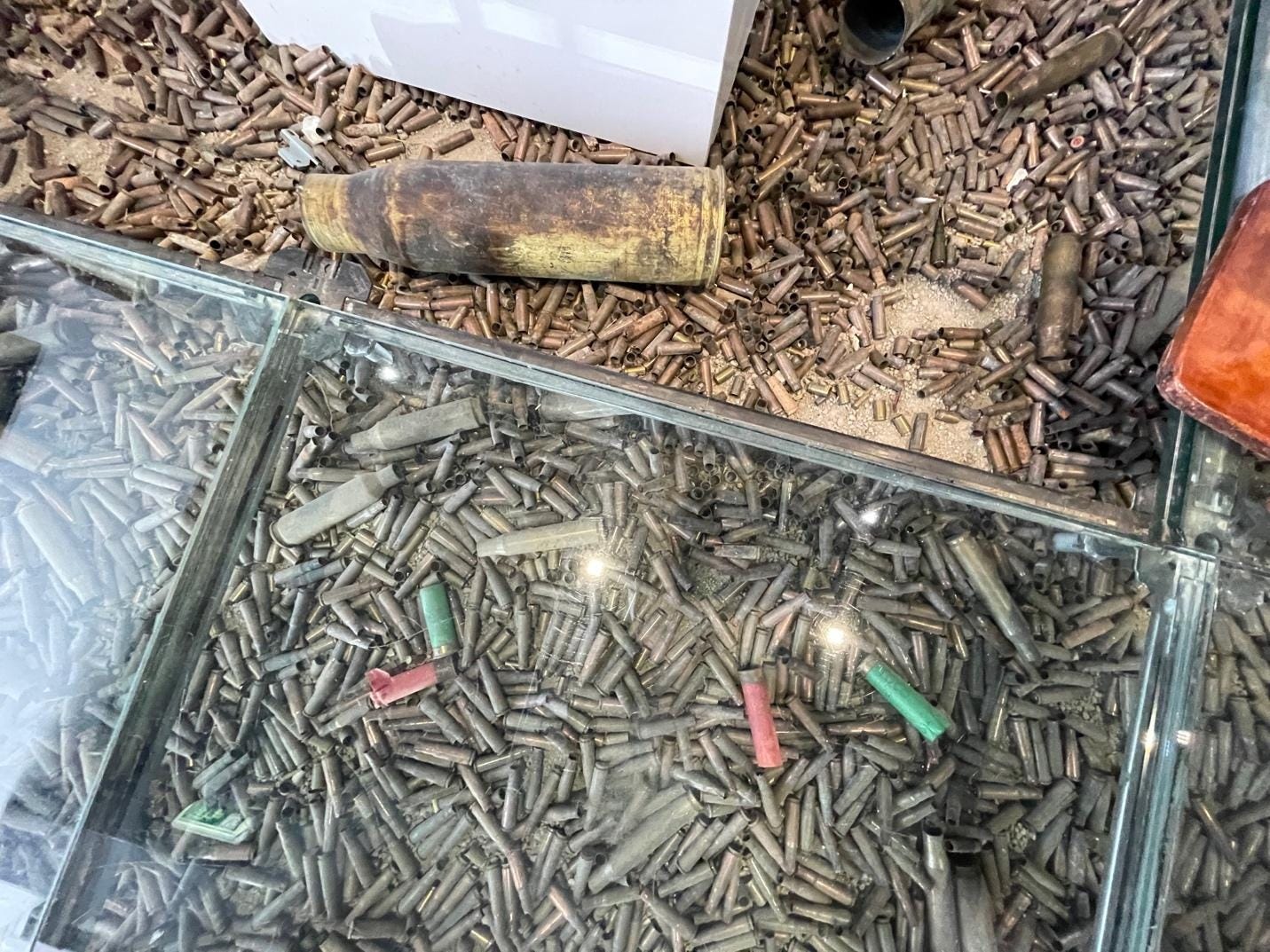
The blockade is not nearly the extent of the US war on the island: over the last 66 years, the US attempted to kill Fidel over 600 times, committed numerous acts of terrorism, waged biological warfare, and subjected the island to a constant barrage of anti-communist propaganda. In a particularly shameless example of the latter, the US operates an anti-government radio and television station in Florida called “Radio y Televisíon Martí,” which is named after José Martí, a hero of the late 19th century Cuban independence struggle and a central figure in Cuban revolutionary iconography and historiography.
The blockade: from the special period to the Trump period
The blockade is enforced through a range of legal tools that the US deploys to cut off Cuba’s access to global markets—for both imports and exports. I won’t detail its full scope or the history of its evolution here, but I will highlight a few key points.
When the Soviet Union fell apart in the early 1990s, it had a devastating impact on Cuba’s economy, as it did on the economies of every country in the Soviet Bloc (it was the most rapid period of de-development outside of wartime in human history). Cuba responded to the crisis, which is known as the “Special Period,” with a variety of creative approaches, including a degree of economic liberalization.
The US responded not by lending Cuba a hand or softening the blockade, but by passing the Helms-Burton Act, signed by President Clinton in 1996. The Helms-Burton Act, which has been a key pillar of Trump’s escalations against Cuba, dramatically expanded the extraterritorial reach of the US blockade.2 Among other things, the law imposed the beginnings of a secondary sanction regime, subjecting non-US, non-Cuban corporations that do business with Cuba to potential legal and financial penalties in the US. Virtually every country in the world, including close US allies, condemned the act for its intrusion into other countries’ sovereignty. Several countries, including Canada, passed laws that sought to protect corporate actors in their jurisdiction from the long legal arm of the US. Despite global opposition, US use of unilateral sanctions and extraterritorial measures has continued to expand since the 1990s.
The blockade eased somewhat under the Obama administration when the US government decided to take a new, softer approach to regime change. Trump reversed Obama’s course and began a project of “maximum pressure” during his first term. He imposed new sanctions, reinstated all provisions of the blockade, curtailed US tourism to Cuba, and, eventually, listed Cuba as a state sponsor of terror, a dramatic escalation that makes it difficult for Cuba to access the international financial system (and thus to do trade of any kind).
President Biden, for his part, failed to reverse virtually any of Trump’s Cuba policies until January 14th, 2025, just six days before Trump returned to office. On his first day, Trump re-listed Cuba as a state sponsor of terror and undid most of Biden’s other last-minute actions.
In January 2026, Trump issued Executive Order 14380 which threatened punitive tariffs against any country that sold oil to Cuba, imposing the energy blockade that has persisted for the last five months. Cuba produces some oil domestically, but it is heavily reliant on imports of refined products like fuel and diesel, and also of crude, which is burned in thermoelectric power plants to generate electricity. The oil blockade has kicked off one of the worst periods in Cuban history.
Since the end of January this year, just one (Russian) oil tanker has landed in Cuba. This sounds bad enough in the abstract but it’s worth thinking through the implications and their negative feedback loops, many of which we witnessed in person.
Without oil and consistent electricity, Cuban industry can’t operate, whether that’s the nickel mine in the east or the sugar cane industry (which also generates biomass-based electricity and is used to produce exports like rum). The shutdown of the sugar cane industry alone put hundreds of thousands of people out of work overnight, and the longer the industry is shut down, the longer it will take to return fields and mills to production when the crisis is over.
Compounding the matter, without its industrial exports and with tourism dramatically curtailed, Cuba can’t access foreign currency, which it needs to buy essential goods like oil, fuel, and staple foods on the international market.
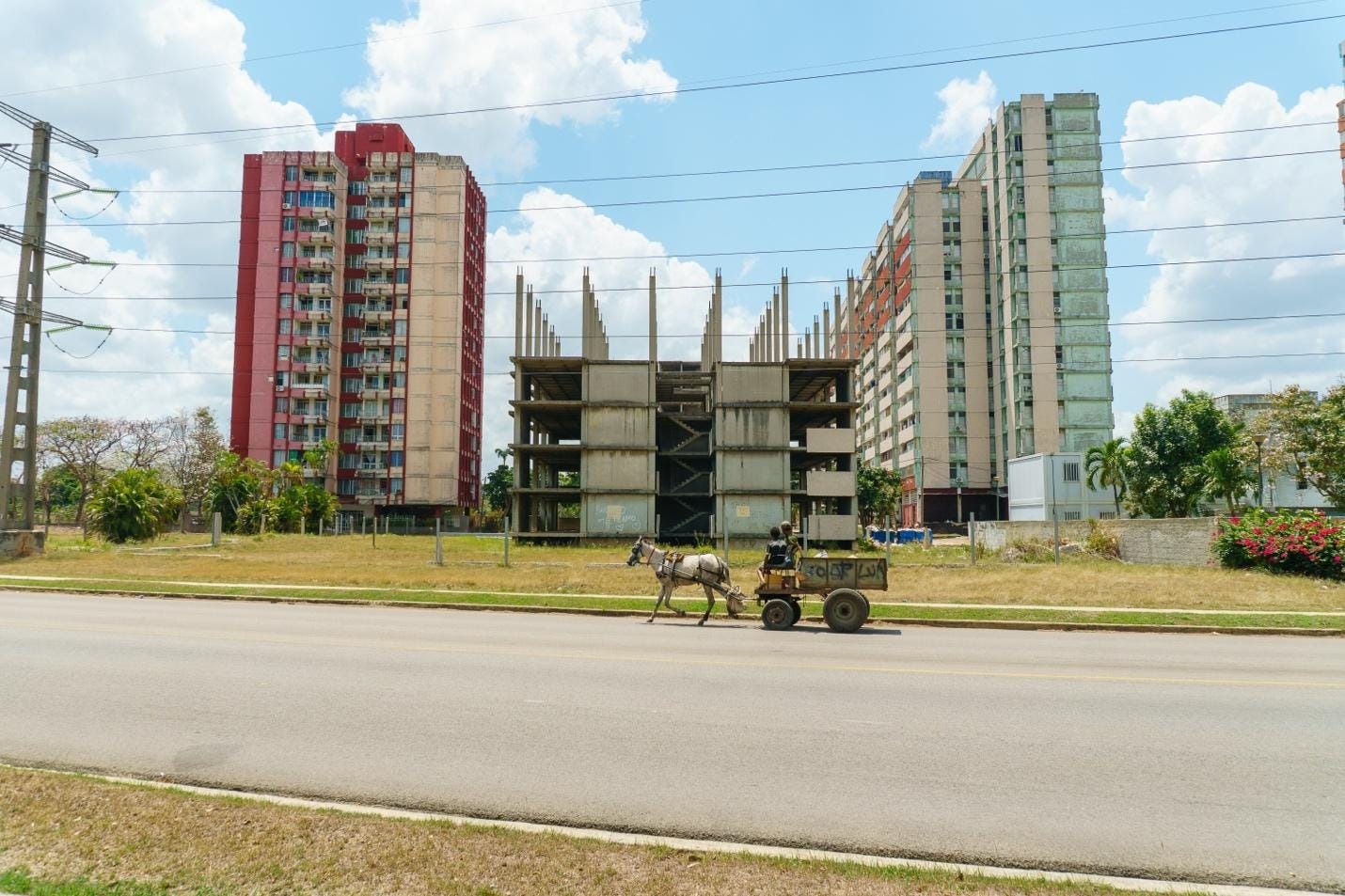
Shortages of fuel also mean that people can’t commute to work. Students can’t commute to school. Patients can’t commute to hospitals or clinics. To Cuba’s credit—and to be clear, this is possible only because Cuba is a socialist country with a planned economy—the country has proven remarkably capable of dealing with this situation. Cubans out of work are growing food for subsistence; schools are operating part time to take advantage of windows of power availability and to minimize commute requirements; universities are experimenting with different approaches to solve the problems of patchy internet connectivity and unavailable transportation, including by having students that would otherwise be commuting from other parts of cities stay on campus for intensive multi-week periods. The sugar cane workers’ union is supporting its members while it works with the public conglomerate that operates the industry to ensure that it can return to operations when the energy blockade ends.
And Cuba is pursuing a rapid energy transition. It installed one GW of solar capacity in 2025, nearly 20 times as much as Canada, and it intends to install another GW this year—if its Chinese suppliers can make it past the US Navy. The less its electric grid and transport sectors rely on fossil fuels, the less vulnerable the country will be to the whims of the Miami Cuba lobby and its allies in the White House. Most of Cuba’s new capacity in 2025 came in the form of utility-scale solar parks, but we saw rooftop solar everywhere we went. I even saw a number of electric tuktuks with what appeared to be 800 watt solar panels fixed as their roofs.
On May 1st—a date chosen for obvious reasons—Trump issued a new executive order that imposed sweeping secondary sanctions and additional restrictions on US citizens visiting Cuba, going so far as to ban humanitarian donations. These kinds of sanctions aren’t laws, exactly, and when they are so broad, it is difficult to tell how they will be applied. But we’ve seen a few things happen over the subsequent month that help paint a picture of how the Trump administration intends to use them.
In Cuba, within days of the sanctions announcement, we heard that European technicians who had been on their way—literally at the airport—to help troubleshoot some of Cuba’s energy infrastructure received a phone call, presumably from the US government, after which they canceled their trips. We heard, too, that suppliers Cuba had worked with for years began cancelling orders, including for equipment that had already been paid for.
By May 4th, the Canadian company Sherritt, which operates the country’s nickel mine and a gas-fired power plant through joint ventures with the Cuban government, announced it was suspending its joint venture operations. Three of its board members resigned. By May 20th, Sherritt had signed an agreement that will allow Gillon Capital LLC, an investment firm belonging to billionaire Trump ally Ray Washburne, to buy a majority stake not just in the joint ventures but in Sherritt itself at a significant discount. Trump’s sanctions, in this instance, have served a dual purpose: crippling Cuba by destroying one of its largest export industries and enriching his cronies by forcing a company to sell itself to them.3
Many of the hotel companies that operate in Cuba are following suit, and Trump and his allies undoubtedly hope to pillage their assets. The Trump administration has also continued to tighten the noose by explicitly listing Cuban organizations as sanctioned entities.
Much of this is new with Trump, but it’s important to understand that while it is an escalation, it is also very much a continuation of existing bi-partisan policy.
The Antonio Guiteras Thermoelectric Power Plant, a critical component of Cuba’s electric grid, was originally built by the French company Alstom in 1988. For decades, Alstom supported Cuba like any other customer, sending technicians, selling spare parts, and helping Cuba operate the facility as needed. In 2013, the US arrested two Alstom executives at JFK Airport in New York. That kicked off a multi-year pressure campaign against Alstom that culminated, according to one of the executives (Frederic Pierucci, who spent two years in US prison), in General Electric’s purchase of Alstom’s energy business. The sale went ahead against shareholder wishes and those of the French government, driven, according to Pierucci and then-minister Emmanuel Macron, by US pressure against the company’s CEO and board.
After the sale, GE immediately cut ties with Cuba, forcing the country to search for alternative suppliers for spare parts and to develop their own approaches to dealing with problems at the facility.
Other mechanisms of the blockade have also limited Cuba’s access to technical expertise, spare parts, and so on. US export controls, for example, limit the re-export of anything with more than 10% US-made components to Cuba, meaning that companies all over the world must assess their supply chains to ensure they don’t sell goods to Cuba with US-origin components. Because supply chains are so opaque, this has had a chilling effect, leaving Cuba with fewer and fewer suppliers of high-tech goods and spare parts over time, undermining all sectors of the economy, including particularly their energy sector.
As a response to this, the Cuban energy workers’ union has a nationwide, cross-profession “innovation group” that is tasked with coming up with impossible solutions for technical problems. They are a MacGyver team that has kept Cuba’s energy infrastructure running in the face of Herculean challenges. In late April, while I was in the country, Cuba announced an example of this: they had developed a technique for refining domestic oil into fuel, diesel, and naptha, something they hadn’t been able to do until that point.4 This new capability means that as Cuba transitions its electricity grid towards renewables, it will be able to redirect domestic oil towards transportation and other fuel needs, a major step towards energy self-sufficiency.
Trump’s May 1st sanctions were also broad enough to criminalize international solidarity in ways that the US has not previously tried. Organizations like the Canadian Network on Cuba, which coordinated my trip to Cuba, or even non-US individuals, could be targeted at the whim of the Office of Foreign Assets Control (part of the Department of the Treasury). You might wonder how the US could target a Canadian with no assets in the US. Unfortunately, US banks play an intermediary role in almost all international transactions thanks to US dollar dominance and US control over the infrastructure of international settlements. This, along with the pliancy of foreign governments and banks, means that the US can effectively cut any individual out of the global banking system by fiat, leaving them with little recourse. How can you pay for a lawyer in the US if your bank accounts are frozen?
Simple tasks, from booking an Uber to reserving a flight or hotel room, became impossible. Bank transfers now included uncertainty over whether they would sail through the system or be rejected. Following the cancellation of her Amazon and Google accounts, Prost lived with the constant worry that her other accounts would also vanish. “Everything becomes such a challenge,” she said.
The Guardian on the impacts of sanctions against Kimberly Prost, a Canadian citizen who sits as a judge at the International Criminal Court and is sanctioned by the US for the court’s indictment of Israeli war criminals. Prost also explained that you are immediately cut out from credit card systems, as well.
For US organizations and individuals, the mechanisms are different, but they, too, can be targeted for solidarity work. Indeed, on May 23rd, the Trump administration issued subpoenas for the popular left-wing streamer Hasan Piker and Medea Benjamin, a co-founder of CodePink, digging into their participation in the February Nuestra América flotilla. Fox reported that these subpoenas are part of an investigation into 40 US citizens that participated in that flotilla.
We have yet to see the entire picture when it comes to the new sanctions, and there is the constant explicit threat that they will be paired with military action.
What Cuba reflects back onto global north activism
For someone from North America, or probably anywhere in the global north, traveling to Cuba is like traveling to another universe: the place is covered in revolutionary iconography and alive with revolutionary spirit. Some of it is Cuba-specific—imagery of Fidel, Che, José Martí, and other national heroes—but as much of it is international and internationalist: I walked past monuments to Salvador Allende and Simón Bolívar, past countless murals about Palestine, past El Teatro Karl Marx. The spirit of internationalism, of revolution, and of international revolution is alive in Cuba in a way that it isn’t anywhere else, today, as far as I know.
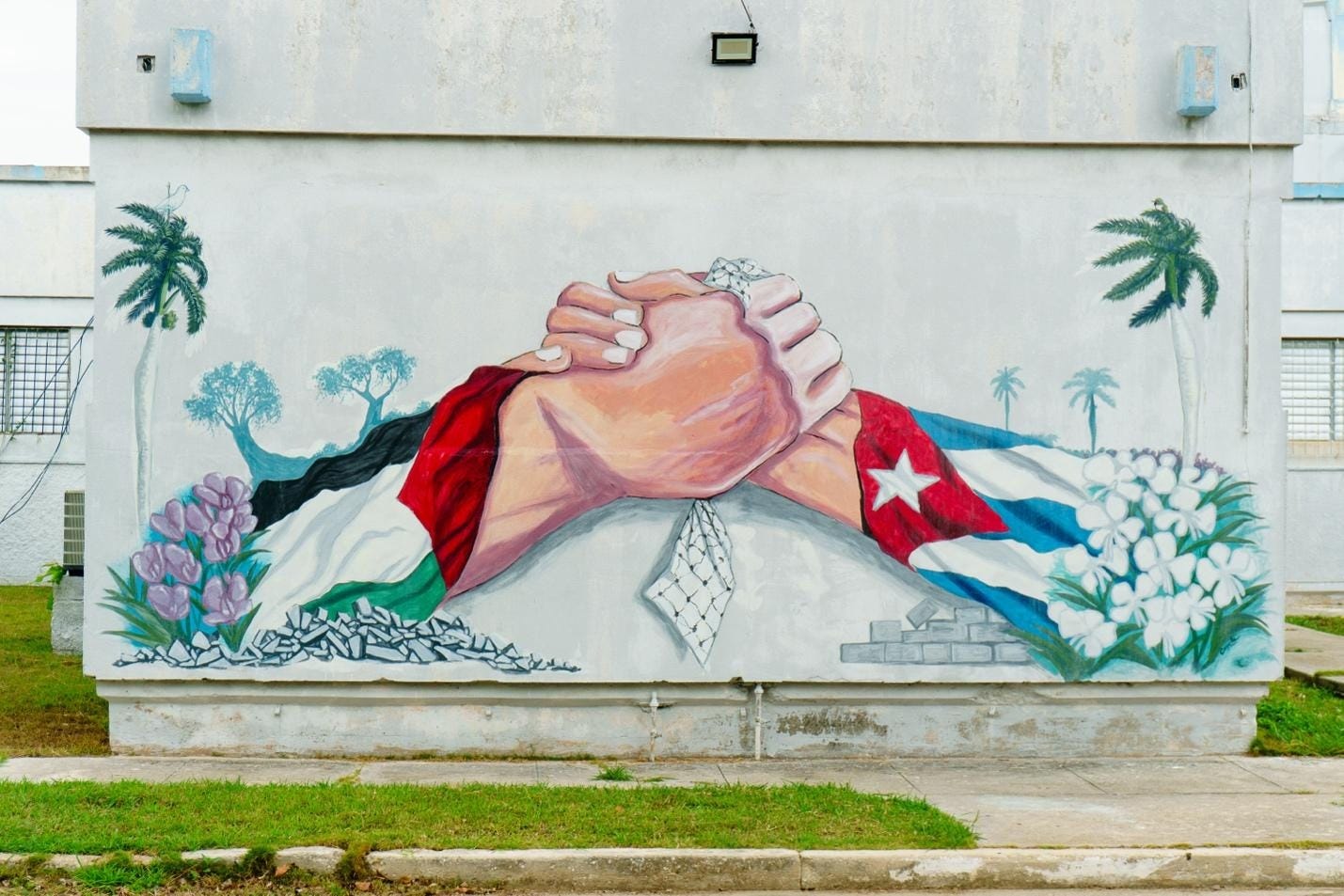
It is inspiring and empowering to be there. But seeing Cuba’s steadfast commitment to a self-consciously socialist, humanist, and developmentalist internationalism left me thinking about some of the ways that our radical movements in the global north have perhaps lost the plot, or to be more specific, ways our radical movements have inadvertently transposed the circumstances of our local struggles (against fossil fuels, against capital, etc.) onto the rest of the world.
On oil, national development, and work
In the world of climate justice, oil is the bad guy. This is not an unreasonable position. Oil and other fossil fuels, after all, are the principal drivers of climate change, and fossil fuel pollution is a textbook environmental justice issue in countries like the US and Canada. The challenge, though—and I want to be very clear that I am trying to say something more subtle than the right-wing, climate denialist point about energy poverty here—is that for most of the world, oil is still critical for development, particularly in countries where oil is controlled by national governments and profits are deployed for domestic benefit rather than siphoned off by northern capital (e.g. Iran, Venezuela until recently).
Iran and Venezuela are oil exporters, a status that comes with its own complexities. Cuba is not: it produces domestic oil, but that oil is burned to generate electricity and—as of a few weeks ago—refined to produce fuel for domestic use.
In Cuba, everyday people know the names of their thermoelectric plants. They know about Cuban oil production. They know when Cuban scientists innovate new ways to refine domestically produced oil, reducing dependence on imports. These things are crucial to mitigating the genocidal assault levied by the Trump administration, to national development and meeting people’s needs, to building a future for Cuba. Cubans are proud of their energy sector—and rightfully so.
Being there, I found myself inspired by their innovations in and management of the oil and gas sector, something that I think readers will likely find as strange as I initially did. But that strangeness, in my view, is indicative of a tendency to transpose our political circumstances in the north on the rest of the world. Yes, northern climate justice movements do talk about “fair share” approaches to climate mitigation which prioritize drawdown of fossil fuel industries in global north countries first, but in practice there’s relatively little differentiation made. We would do well, from my perspective, to develop a more nuanced global perspective that differentiates the politics of fossil fuels not just between north and south, but also between neo-colony and sovereigntist development project. It’s different, for example, when Cuba’s state-owned enterprises develop their oil resources for domestic consumption than it is when Exxon and the World Bank conspire to exploit Guyana’s offshore oil at robber-baron rates.
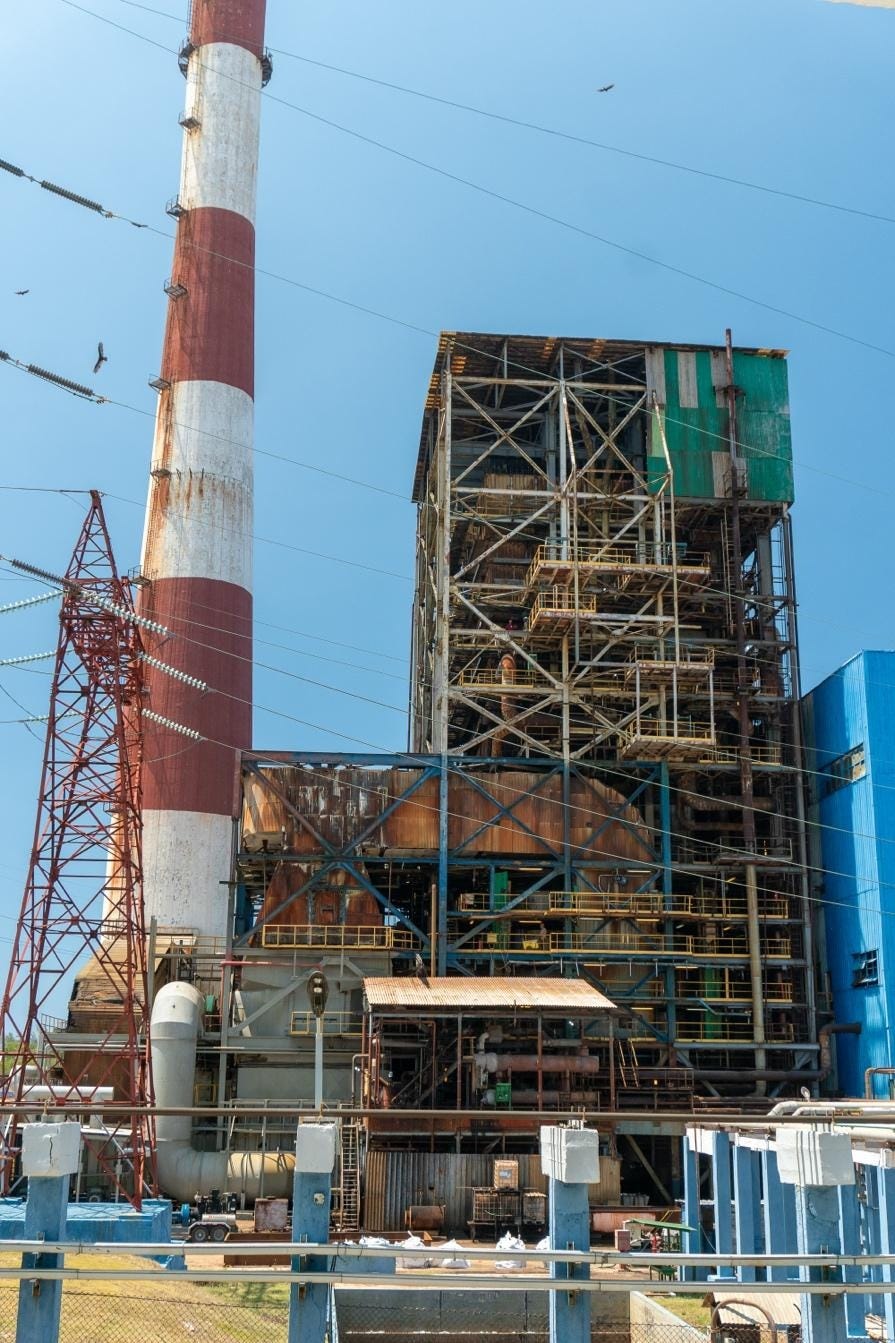
The concept of “extractivism,” in particular, is often used to blur these distinctions away, rendering, say, the left-wing Correa government in Ecuador equivalent in its fossil fuel development to Canada, or to Chevron operating in Nigeria. I don’t mean to write the entire discourse of extractivism off here—there are definitely scholars of extractivism who navigate this complexity carefully and in analytically useful ways. But there are many who don’t, and the broader discourse of extractivism, particularly as it extends beyond the academy and into activist spaces, has a tendency to diagnose fossil fuel development as a problematic symptom of an idea or worldview that exists beyond or in parallel to capitalism. This tendency erases the realities and trade-offs involved with surviving under a constant barrage of imperialist assault.
The point is not that we can’t be critical of fossil fuel development in the south. Cuban economists described the country’s energy transition plans to us, and while they are quite bold (by necessity), they are still held back by outdated assumptions about the impossibility of 100% renewable grids and the need for “baseline” gas generation. I think Cuba can and should aim higher—they could establish a 100% renewable grid rapidly and with a remarkably low level of investment given the will, the access to capital, and the ability to import goods freely. Unfortunately, the latter of those two conditions are missing and while that is the case, oil and gas development, including, where possible, the expansion of production, is an absolute necessity for the country’s survival and for its sovereignty. This is the world we actually live in, not the world we wish we lived in, and it is the world in which our politics must be grounded.
The question of “work” raises a similar issue. On our first full day in Cuba, an economics professor answered a question from our group about whether people had to work multiple jobs to survive right now because of the cumulative impacts of Trump’s sanctions regime on the Cuban economy. The answer was yes. Some people had a reaction to this that seemed to blame the Cuban government—to presume that wages could be higher if the government simply mandated it, and that it was a recalcitrant government acting in opposition to labor that prevented this from happening. This, in my view, is also a projection of a global north circumstance onto a very different situation in the south, and it speaks to our understanding of the nature of work and society. What is work, and what does it accomplish?
In the north, we often act with an unspoken assumption that most jobs are “bullshit jobs” in the David Graeber sense. Our work, as we understand it, isn’t actually necessary or even contributing in a serious way to the continued reproduction of society—to the production of things or the provision of services and care that sustain our societies. This is probably true for many jobs in countries like the US and Canada, and it may be true for some jobs in poorer countries. But it’s certainly not true for the majority of jobs in a place like Cuba, which is systematically deprived of the means of social reproduction, including in particular the modern technologies that increase worker productivity (output per unit labor).
A certain amount of output is necessary to keep people alive, to maintain healthcare and educational systems, to sustain society. Unequal distribution of productive infrastructure—machinery, technologies, etc.—between the global north and the global south means that for the same amount of social wellbeing, more hours of labor are required in the global south than in the global north, a situation compounded by the blockade in Cuba. More person-hours of work, in other words, are needed to sustain society in the global south than in the global north: more people farming, more people working in the energy sector, more people teaching and providing medical care, and so on. The reason Cubans currently have to work two jobs, in other words, is because of the destruction of productivity that Trump’s escalations have caused. No oil means no tractors.
The reason wages can’t be higher in Cuba right now is because of this situation: many services in Cuba are provided outside the market, but Cuba also has a functioning market economy that people rely on for necessary purchases. If the Cuban government raised wages, it would very quickly cause inflation because there literally isn’t more to go around. As John Meynard Keynes once put it, “We can afford whatever we can do”—the limitation in Cuba is that they can’t do more because of the blockade. More Cuban pesos in people’s pockets will not increase the amount of production that’s happening in the country, nor will it increase the amount of foreign currency coming into the country, a necessity for importing goods. Work, in Cuba, very concretely contributes to both of those, and the necessity for people to work two jobs is about a mismatch between the minimum social product needed to reproduce society—that which is required to keep food, healthcare, and other basic needs met—and productivity and available workforce. Raising wages without solving the other problems wouldn’t increase the amount of food or oil available on the island which is the crux issue.
To me, this speaks to a disconnect in radical spaces in the global north between an imagination of work as a western enterprise that we could move beyond with the right epistemological orientation and the realities of what is involved in social reproduction. To work is to be human; to work is to apply our energy to the world around us in order to produce and reproduce ourselves and those around us. To work is not fundamentally capitalist, nor is it even fundamentally western. It is a requirement, a fundamental feature of life itself—unless one subscribes to the naïve techno-utopian futures of certain swathes of the western left.
Cuba is a society that is being forced to work overtime just to survive. When we project our perceptions surrounding the nature of work and wages from the global north onto Cuba, we move the agency away from the actual perpetrator imposing this circumstance—the United States—and onto a revolutionary state that is trying to adaptively manage an impossible situation with the tools it has available.
“Patria o muerte” y “patria es humanidad”
There’s something powerful about standing in front of the opaque concrete of the US embassy and yelling “Patria o muerte, venceremos” with tens of thousands of Cubans while glancing furtively at the ocean—towards Miami—wondering if May Day might be the day Trump decides to launch his assault on Cuba. “Patria o muerte” means “homeland or death.” It’s a national motto and a commitment regularly repeated by the Cuban people. It’s not just a slogan, though: Cubans have fought to defend the revolution many times over the last six decades, and for all the propaganda printed in the west about the country’s imminent collapse and the alleged unpopularity of its government, Cubans seemed ready to fight today if it comes to it. You can imagine why, I think: the prospect of being bombed and re-colonized by the fascists next door is not exactly appealing.
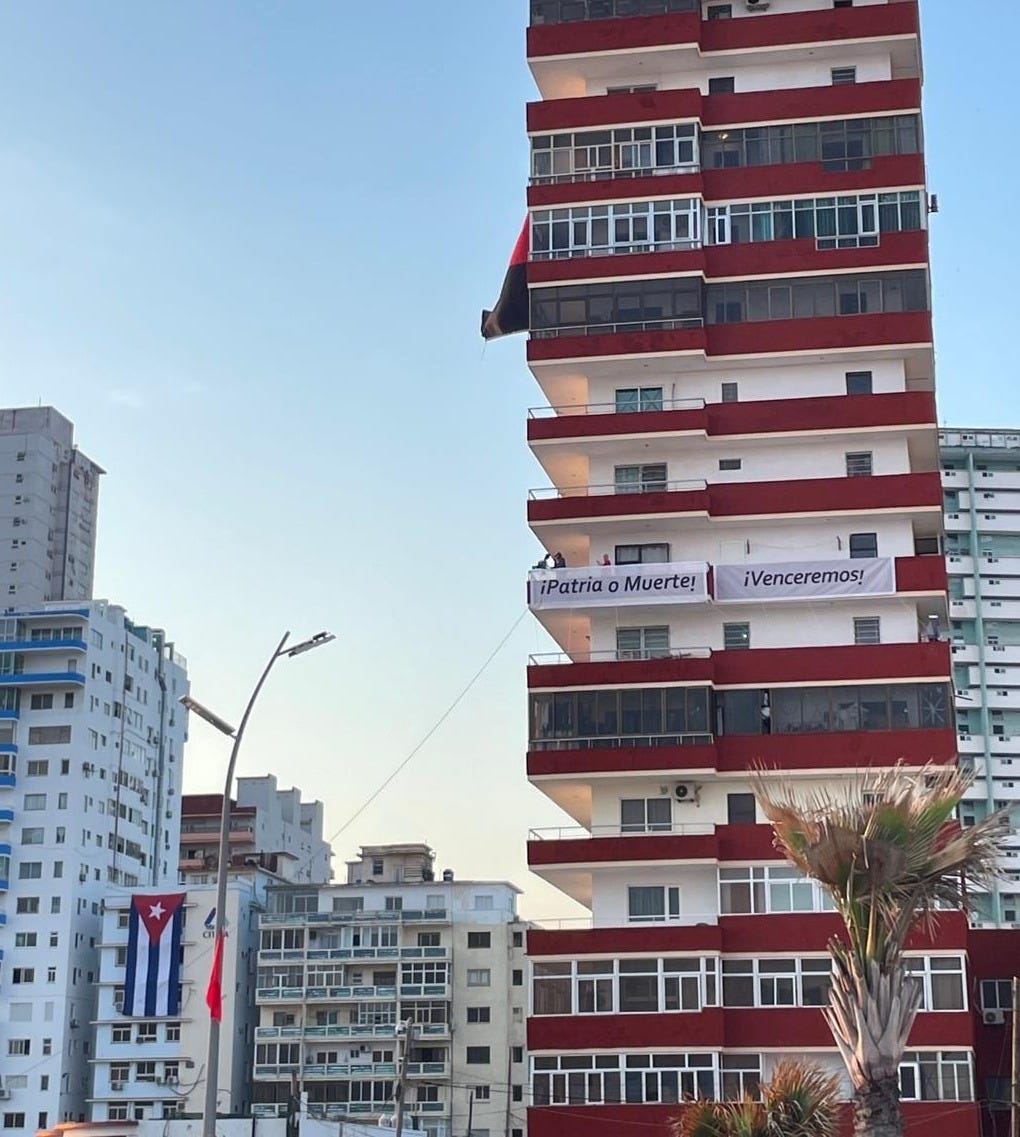
The idea of giving one’s life for one’s country is probably not something most of us in the global north would embrace, but it is generally within the realm of cultural understanding: many figures in our history books have said the same, and prior to the era of neoliberalism, similar sentiments seem to have been at least somewhat common.
What’s so interesting about Cubans’ commitment is not their willingness to die for their country. It is the pairing of “patria o muerte” with another revolutionary slogan: “patria es humanidad,” or “homeland is humanity,” a statement made by José Martí in 1895. This, I think, begins to reach well beyond the comfort zone of those of us in the global north. It also pushes the limits of some forms of radical activism and solidarity in the global north and contains important lessons for us.
In 2024, as the struggle over the latest pipeline in northern British Columbia was heating up, I attended and reported on a meeting where a hereditary chief of the Gitanyow people stated, “We are willing to die on this land.” I can’t speak for that chief’s motivations. But I do want to speak about how, in activist circles, we digest statements like these. We understand them as rooted in land: the willingness to give one’s life is based on a commitment to a specific place, based on longstanding relationships with that specific landscape. The Palestinian struggle—and the commitment of Palestinians to that struggle—is often made legible in the same way. It is the indigeneity of Palestinians, in this understanding, that both enables and compels them to persist and resist.
Cubans are no strangers to this commitment to land: Cuba is their homeland, and they are ready to give their lives for it.
But Cubans also gave their lives recently in Venezuela defending President Nicolás Maduro. Cubans also gave their lives in Angola and Namibia fighting for those countries’ independence and helping to end apartheid in South Africa. Che Guevara himself gave his life in Bolivia. And the Cuban commitment to risking their lives for international solidarity goes far beyond the military realm: Cuban doctors have been the first on the frontlines of many of the worst ebola outbreaks in Africa, and they played a well-known role in providing emergency medical relief in some of the places hit hardest by COVID-19.
It is this pairing of “patria o muerte” and “patria es humanidad” that explains this deep commitment to international solidarity: Cubans are willing to risk their lives far beyond their own borders because they understand that homeland not simply as the island known as Cuba, but as a universalist dignified humanity. For Cuba, to fight for human dignity is to fight for one’s homeland, and the history of Cuban internationalism makes it clear how firm this commitment has been since the earliest days of the revolution.
This expansion of the idea of homeland beyond specific geographies goes in another direction, too: as country after country in Latin America fell to US-backed dictatorships during the second half of the 20th century, Fidel told his fellow revolutionaries in those countries that if they were forced from home, not only could they seek safety in Cuba, but Cuba would be their homeland, their patria. Cuba, in this view, is not a homeland for a people who are uniquely Cuban in some way that no one else can ever become. It is a homeland for all those fighting for human dignity, a bastion of humanity and dignified human existence in a world dominated, for now, by barbarism.
In this revolutionary perspective, the land, the people, and a dignified future for humanity are all inextricably connected. It is a land-based politics of internationalism, not exclusive of the kind of commitment to land that we see in Indigenous struggles in North America today but rather encompassing of it and going beyond it. This is along the lines of the kind of Indigenous internationalism Glen Coulthard, a Dené scholar, has identified in the history of the Red Power movement. Both Indigenous and non-Indigenous politics in North America have a lot to learn today from the Cuban commitment to internationalism and the way land and internationalism can fit together to produce a coherent and material politics of solidarity.
What is to be done?
The spirits of resistance and resilience in Cuba are strong, but there’s only so much spirit can accomplish. At some point there’s no more rice. Trump keeps escalating, and while countries like China and Russia have pushed back on Trump’s strangulation, it hasn’t been enough to stop it, and US allies like Canada have failed to even make a serious statement about what is being done.
Trump may also escalate to a military assault on the island at any time. It seems unlikely that they will put “boots on the ground,” given the likelihood of a quagmire, but at this point, what’s to stop the Trump administration from simply bombing Cuba’s beautiful cities to oblivion?
Unfortunately, while Cuba’s ability to resist continues to amaze me, the reality is that the answer to that question lies principally not in Cuba, but in the United States, and to a degree in Canada, the UK, and Europe. The US assault on Cuba is a criminal assault on human dignity. It is also an assault on a people with the “intent to destroy [them], in whole or in part.” It is, in other words, an act of genocide.
I don’t have the hubris to suggest that I know what to do about this. But I do want to communicate the urgency: the US is attempting genocide against Cuba and it is getting worse by the day.
If this was being done to you or I, Cuba would be there for us. Cuba is there for us, even in these worst of times: Cuba runs a medical school that trains doctors from impoverished communities, including in the United States, free of charge, who then return home to provide care to those left behind by the abominable American medical system.
The question we have to be asking now is, how can we be there for Cuba?
Cuba Solidarity Organizations
To be clear, the above is a rhetorical question, but a good starting place is join an existing organization that is active in Cuba solidarity, so I’m including a non-exhaustive list of organizations here.
If you are a unionized worker, your union is likely the first place to start for Cuba solidarity work: many unions in both countries are actively involved and send delegations to Cuba every year. If your union doesn’t already work on Cuba solidarity, see if your union has an international solidarity committee and go from there; if it doesn’t have one, talk to your co-workers about starting one!
Canada
Canadian Network on Cuba CNC is an umbrella organization that runs the annual Che Brigade. Check out their “member groups” page to find more local organizing opportunities.
United States
Unfortunately I don’t know the landscape in the US very well, but here are a few organizations that are actively working on Cuba solidarity:
Some Recommended Reading and Listening
Blowback Season 2 [podcast]. One of the best podcasts I’ve ever listened to. A really in-depth history of the revolution and the subsequent decades of US warfare against Cuba.
Upstream Cuba series [podcast]. A shorter more holistic look at Cuba from the late colonial period through the present, including a few episodes on how Cuba works today.
Devil’s Chessboard (2015) by David Talbot. Very long, but very engaging. A biography / history of the political activities of Allen Dulles and the CIA. Extends well beyond Cuba but paints a good picture of the centrality of the CIA’s Cuba operations in the overall trajectory of US politics in the Cold War era.
May Day, for most of the world outside the Anglosphere.
The US Supreme Court just ruled, on the basis of a provision in Helms-Burton that had been waived by each president until Trump in 2019, that four cruise ship companies that stopped in Cuba during the Obama period could be held liable for $400 million by an American company that once held a non-exclusive lease to use the same docks. It’s as absurd as it sounds.
You can read more about the Canadian government’s utter failure to do anything to defend Sherritt, which has a long history of opposing the US blockade, in an opinion piece I wrote for Canada’s The Hill Times at the end of May.
Cuban oil is both heavy and sour, so they had relied on imported oil for refining.